Findings Uncover Early Signs of Economic Slowdown
SAN FRANCISCO--(BUSINESS WIRE)--Jan. 31, 2019--
Yelp Inc. (NYSE: YELP), the company that connects people with great
local businesses, today introduced the Yelp Economic Average (YEA), a
new benchmark of economic strength.
This press release features multimedia. View the full release here:
https://www.businesswire.com/news/home/20190130005915/en/
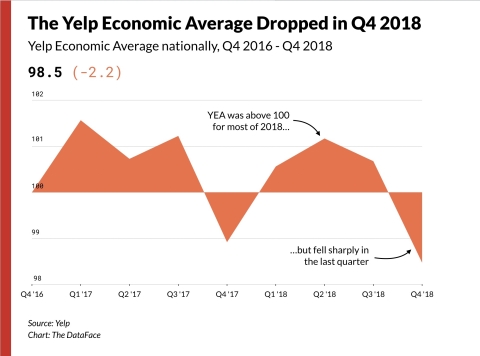
Yelp Economic Average (Graphic: Business Wire)
Today's data resources for measuring economic health generally either
focus on giant corporations or move at a glacial pace. Yelp has
information on millions of U.S. businesses and the interests and needs
of our 34 million monthly app users and 75 million monthly mobile web
users, which researchers
have found makes us well positioned to accurately and quickly
measure a huge swath of the economy that is missed by many major
indicators.
From sandwich makers to sporting-goods sellers, business sectors
throughout the economy are slumping, according to Yelp data. Over the
past quarter, the YEA fell by more than two points, due in part to
declines in the professional services, shopping, and other categories.
Slumps in core business sectors may be early signs of an economic
downturn. A second successive fourth-quarter slump isn’t a result of
seasonality; we’ve normalized the data so that it is seasonally adjusted.
Of the 30 business sectors represented by the Yelp Economic Average
(YEA), only one—gas stations—saw an increase in the fourth quarter of
2018, resulting in a national decline to 98.5 from 100.7 in the third
quarter. All YEA scores are calculated relative to the fourth quarter of
2016, for which the score was set to 100.
The downturn left few business sectors untouched. Everything from
high-end retail such as jewelry stores and antique shops to pricey
professional services such as private eyes and architects were hit hard
in the fourth quarter, in a trend extending to sectors beyond our core
30. So were more routine discretionary offerings, such as burger places,
bars and coffee shops.
The handful of sectors to buck the trend and rise in the quarter
includes self-storage facilities, which can be countercyclical, thriving
when people downsize homes or need to upsize homes but can’t. For an
interactive look at the specific category and business sector trends
included in the YEA, visit our blog, here.
Amid all the declines, a few in particular caught our eye. Here’s our
best guess about what could be driving the change.
With marriage rates remaining well below previous generations’, and the
newest newlyweds staying together longer, one line of business that
caters to married people is struggling: divorce law. The category was
down six-tenths of a point last quarter, though it remains strong in the
Midwest, with a 5.4-point increase in the region.
Sandwiches and baked goods also are struggling, with fourth-quarter dips
exacerbating long-term declines. Low-carb diets remain
popular despite mixed scientific findings, while the increased
availability of gluten-free foods may be taking consumers away from
their traditional sources for bread-based products.
As more Americans spend
more time on their phones accomplishing a greater number of tasks,
that’s hit businesses that sell
computers and ones that sell computer-repair and IT services—two of
the 30 sectors included in YEA.
We’ve made something a little different than well-known economic scores.
The Dow
Jones Industrial Average, the Standard
& Poor’s 500 Index, the Nasdaq
Composite Index, and other stock indexes measure the value of
companies so big they’re owned publicly. The Gross
Domestic Product bundles the local consumer economy with
business-to-business commerce and national and multinational firms.
YEA, by contrast, is a measure of the Yelp economy, which underpins the
local economy. A successor to Yelp’s long-running Local
Economic Outlook, YEA is inspired by the major stock indexes. They
track the stocks of major companies while YEA tracks the fortunes of
businesses in 30 important sectors on Yelp, drawn from the backbones of
the Yelp economy: restaurants, retail and service companies. On Yelp,
people join
the waiting list remotely at places to buy sandwiches, and request
quotes from companies that can clean their offices. Both types of
businesses are represented in our index.
Taking a page from the basket of goods used to calculate inflation for
the Consumer
Price Index, Yelp’s data scientists have identified a basket of
other businesses, chosen for their sectors’ representativeness and
consistency, to form a baseline against which the Yelp 30 are being
compared.
YEA is part of a larger project to surface insights from Yelp’s data to
help businesses succeed and provide policymakers with information to
boost their economies.
Methodology: The Yelp Economic Average (YEA) is a composite
measure of the economy, reflecting both business health and consumer
interest among businesses in 30 sectors.
The eight root categories
The 30 business sectors, or categories—we call them the Yelp 30—are
drawn from eight umbrella business categories
on Yelp: restaurants, food, and nightlife; local services, automotive,
professional, and home services; and shopping.
Root categories’ share of the 30 components
The share of YEA components from each of these eight categories is based
on each one’s share of the economy, as estimated from County
Business Patterns reports.
Choosing the Yelp 30
Each of the Yelp 30 is chosen based on four criteria, relative to other
candidates within its root category, as measured in the first quarter of
2016:
-
Number of businesses on Yelp in the category;
-
Consumer interest on Yelp for businesses in the category;
-
Number of the 50 metro areas—whose economic health we have been
measuring for over a year as part of our Local
Economic Outlook—in which the category is present;
-
Uniform spread across the
four Census Bureau-defined regions of the country.
Choosing baseline categories
We then chose baseline categories against which to compare the fortunes
of the Yelp 30. This step helps remove changes due to seasonality and
Yelp’s internal growth; what remains is a reflection of real economic
patterns. We selected all other root categories not represented by YEA
components as baselines because they provided the most robust controls
against seasonality and activity on Yelp.
Calculating YEA scores
For each of the Yelp 30 in each quarter, its two scores—one for business
population and one for consumer interest—are calculated as follows:
-
Count the component’s total for the quarter;
-
Count the baseline's total for the quarter;
-
For consumer interest only: Divide the component’s total by the
baseline total to get the component’s score;
-
Divide the component’s score for the quarter of interest by the
component’s score in the equivalent quarter in 2016;
-
Multiply by 100 to make 100 a typical score.
Then the two scores are normalized to have the same standard deviation,
so that each contributes equal variation across components. To minimize
the effect of outliers, the final score is the mean of two medians, one
for each set of scores.
We calculated equivalent scores at the regional and metro level to
provide a local look at the state of the local economy.
About Yelp Inc.
Yelp Inc. (www.yelp.com)
connects people with great local businesses. With unmatched local
business information, photos and review content, Yelp provides a
platform for consumers to discover, interact and transact with local
businesses of all sizes. Yelp was founded in San Francisco in July 2004.

View source version on businesswire.com: https://www.businesswire.com/news/home/20190130005915/en/
Source: Yelp Inc.
Yelp Inc.
Liina Potter
press@yelp.com